







Game Description
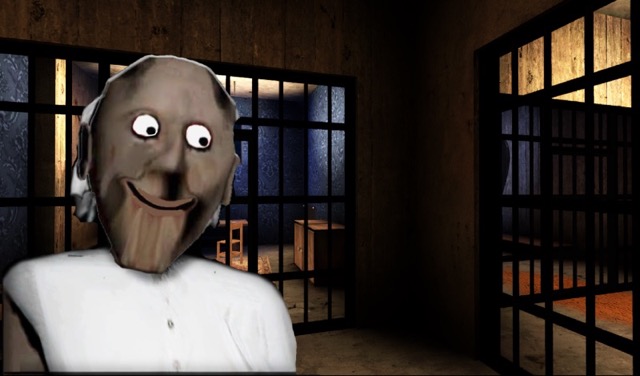
Granny — Prison Escape
1. Game Overview
Granny — Prison Escape has the most theatrical opening of any game in the catalog: you wake up hanging upside down from a ceiling hook, arms roped, head wrapped in scratchy cloth. The room is cold and dim. Granny's footsteps echo from the next hall. Your first task — before you can search a single drawer or check a single lock — is to swing yourself free from the hook using controlled rocking motions.
From there, the game reveals its most distinctive mechanic: a decoy body. Slumped across an old couch is a corpse, and your task is to drape it in a burlap sack and position it in your place on the hook — creating the impression you're still suspended when Granny checks. If she inspects the cell and sees the dressed figure in your position, she moves on. If something is out of place, she alerts. The deception requires precise physical setup — draping the sack, positioning the figure, returning anything you moved to its original position — and any noise during the process risks alerting her.
The prison environment carries through the rest of the game. Cells, drain covers, loose floorboards, panels that don't quite fit, keys taped behind broken paintings, metal bars jammed into the floor. Every search requires careful return of moved objects — leaving crates out of position or tools where they shouldn't be is as alerting as footstep noise. The exit is within reach at the run's end, but one final lock stands between you and the door you'll kick open when you finally get the crowbar into it.
Key Details:
- Genre: Survival Horror / Escape Puzzle
- Difficulty Level: Medium–Hard
- Average Play Time: 20–40 minutes per session
- Best For: Horror escape fans aged 13+; players who enjoy creative, narrative-driven opening sequences; fans of stealth mechanics that include object replacement alongside standard hiding
2. How to Play
Getting Started:
- Rock yourself free from the hook first — Use WS (forward/back motion) to swing on the ceiling hook with enough force to break free. This is a timed physical action — build momentum gradually rather than attempting a single large swing. You cannot proceed until you're on the ground.
- Locate the body on the couch — After landing, find the body slumped across the old couch. This is your decoy material — the component of the escape that makes Granny's patrol inspection survivable.
- Drape the burlap sack over the body and position it — Cover the body in the burlap sack and move it to the hook position — replacing yourself with a dressed decoy that can fool Granny's inspection. Any items you move during this process must be returned to their original positions before Granny checks.
- Search cells, drain covers, and floorboards for tools — After the decoy is placed, begin your item search. Keys are taped behind broken paintings; metal bars are jammed into floorboards; tools appear in drain covers and other non-obvious positions. Each item found advances the escape sequence.
- Return moved objects to their original positions — This is non-optional. Any crate, panel, or object shifted during your search must be returned before Granny's next inspection sweep. Disorder alerts her as reliably as noise does.
Basic Controls:
| Action | Input |
|---|---|
| Swing on hook / jump | WS (swing) |
| Move | WASD |
| Interact | E |
| Jump | Space |
| Crouch | C |
Objective: Escape the prison cell block by rocking free from the ceiling hook, constructing a body decoy to replace yourself in Granny's inspection view, searching cells and drain covers for tools and keys while returning all moved objects to their original positions, hiding in lockers when necessary, and ultimately prying open the final locked exit with a crowbar.
3. Game Features & Highlights
- ✓ Ceiling hook opening sequence — A physically distinctive, momentum-based escape from an upside-down suspended position — the most theatrical game opening in the catalog
- ✓ Body decoy mechanic — Dress a found corpse in burlap and position it as a replacement in your hook position — a unique deception layer that allows Granny's inspection to pass without detection
- ✓ Object replacement stealth system — Moved objects must be returned to their original positions after use — disorder during searching alerts Granny as effectively as sound does
- ✓ Non-obvious search positions — Keys taped behind broken paintings, metal bars jammed into floorboards, drain cover contents — item hiding follows physical logic rather than obvious container prompts
- ✓ Locker and furniture hiding — Standard cover options supplemented by the decoy system, creating a two-layer protection approach for Granny's inspection periods
4. Tips & Strategies
Beginner Tips:
- Build your hook swing momentum gradually using repeated WS inputs rather than attempting a single large swing. The physics require progressive momentum buildup — three or four controlled swings of increasing amplitude will break you free more reliably than one exaggerated input.
- When positioning the body decoy on the hook, take the time to arrange it correctly before Granny's next inspection. A decoy that's slightly mispositioned or missing the burlap sack properly draped will fail the inspection. The time investment in correct setup is less than the time cost of a failed inspection.
- Remember the original position of every object you move during your item search — mentally or by visual anchor with a feature of the surrounding area — before moving it. The replacement requirement doesn't announce which objects need returning; you're responsible for tracking everything you've shifted.
Advanced Strategies:
- Develop a search-and-replace rhythm: move an object, search what's under or behind it, replace it immediately before moving to the next position. This sequential replace-as-you-go approach is more reliable than completing a full section search and then returning all moved objects at once, because the at-once replacement approach requires remembering more original positions simultaneously.
- Locker hiding is your fallback for Granny encounters during active search — but the decoy system is your primary protection during her structured inspection periods. Understand which situation calls for which response: locker for unexpected encounters mid-search, decoy for scheduled inspection windows.
- The crowbar at the final exit is specifically called out in the original copy as a slip-risk moment when hands are figuratively shaking from tension. On subsequent runs, approach the final lock knowing it's the game's final obstacle — the crowbar interaction requires the same deliberate input as any other tool use, not rushed clicking that might cause errors.
What to Watch Out For:
- Leaving moved objects out of position — The object-replacement mechanic is the most easily forgotten system in the game. In the stealth focus of avoiding Granny's footsteps, it's easy to move a crate or panel and walk away without replacing it. Before moving between search zones, pause and check your current area for anything that's been displaced from its original position.
- Noise during the decoy setup — The decoy positioning process requires moving the body across the cell to the hook location. Any loud contact with cell walls, bars, or floor surfaces during this transit alerts Granny. Move slowly and deliberately during the body placement sequence rather than rushing to complete it before she arrives.
5. Game Elements Explained
The Ceiling Hook Opening and Body Decoy System Granny — Prison Escape's hook-and-decoy opening sequence is the game's most creative mechanical design and the element that most immediately distinguishes it from every other entry in the Granny series. The hook swing (WS momentum building) teaches the game's physics interaction style before any search or stealth mechanics are introduced — you must understand how to apply controlled force to game objects before you can successfully set up the decoy. The decoy itself is the game's most novel mechanic: positioning a dressed body at your hook position creates a physical misdirection that fools Granny's inspection without requiring you to be hidden during that inspection window. This turns a potential encounter from a hide-or-be-caught binary into a setup-and-maintain sequence — you invest time in creating the deception, then maintain the decoy's condition (ensuring nothing is disturbed that would reveal the substitution) to sustain its protective effect across multiple inspection periods.
The Object Replacement Stealth System Most Granny-genre games focus stealth entirely on sound management — avoid making noise, and you avoid detection. Granny — Prison Escape adds a visual-disorder detection layer through the object replacement requirement. Granny's patrol inspections register environmental disruption — crates out of position, panels not flush, objects moved from their established locations. This means that your search activity leaves traces beyond sound, and those traces must be actively managed to maintain the deception that the environment is undisturbed. The system creates a search behavior that's more methodical than standard Granny games demand: move one object, search, replace immediately, assess the area's visual consistency, then proceed. The replacement requirement is also what makes the prison environment feel genuinely occupied — items aren't just props, they're components of a maintained visual state that Granny's inspection will evaluate.
The Non-Obvious Item Search System The item positions in Granny — Prison Escape follow a physical logic consistent with the prison setting's plausible hiding options: keys taped behind broken paintings (where you'd hide something that needs to be invisible at a glance), metal bars jammed into floorboards (physical concealment in structural elements), tools inside drain covers (maintenance access points no one would search casually). This placement philosophy means that finding items requires thinking about where things could physically be hidden in a real prison cell rather than following the obvious-container logic of standard escape games. The non-obvious positions are discoverable through systematic search of all physical surfaces — paintings that appear decorative but have accessible backs, floorboards with unusual nail patterns indicating tampering, drain covers that can be removed. Players who develop the habit of searching all physical surfaces rather than only obvious containers find items faster across multiple runs.
6. Frequently Asked Questions
Q: How do I swing free from the ceiling hook? A: Use the WS keys to rock your character forward and back while suspended. Build momentum across three or four progressively larger swings rather than attempting one maximum input. When the swing arc is large enough, the momentum will carry you free from the hook and deposit you on the ground. The physics require progressive buildup — controlled repeated inputs are more effective than single large inputs.
Q: How do I set up the body decoy correctly? A: After landing from the hook, locate the body on the old couch. Interact (E) with the burlap sack to drape it over the body, then move the body to the hook position where you were suspended. The decoy must be positioned at the hook and covered with the sack to pass Granny's inspection. During the setup process, move slowly to minimize collision noise with cell surfaces.
Q: What happens if I don't replace a moved object? A: Objects left out of their original position during Granny's inspection sweep will alert her — the visual disorder registers as evidence of your escape activity, triggering a search response equivalent to a significant noise event. Return every moved object to its original position before Granny's inspection rather than batch-replacing at the end of your search sequence.
Q: Where are the most commonly missed item locations? A: The most often-missed positions are the backs of broken paintings (interact with the painting itself, not the wall behind it) and the metal bars jammed into floorboards (look for floorboards with visible disturbance marks or nail patterns that differ from surrounding boards). Drain covers are more obvious once you know to look for them — interact with any drain cover you find to check its contents.
Q: Is Granny — Prison Escape playable on mobile? A: Granny — Prison Escape runs via HTML5/Unity WebGL in desktop web browsers. The control scheme — WS hook swing, WASD movement, E interaction, Space, C — is designed for keyboard-and-mouse play on a desktop or laptop computer. The hook-swing mechanic specifically requires keyboard input that touchscreen controls would not replicate reliably. Desktop play on Chrome, Firefox, Safari, or Edge is recommended.
7. Related Games You Might Enjoy
If you like Granny Prison Escape, you might also enjoy:
- Granny 4 - It offers another browser horror run with related survival, puzzle, or escape pressure.
- Granny 2 - It offers another browser horror run with related survival, puzzle, or escape pressure.
- Granny 3 Original - It offers another browser horror run with related survival, puzzle, or escape pressure.
Comments (0)
Add a Comment