






Game Description
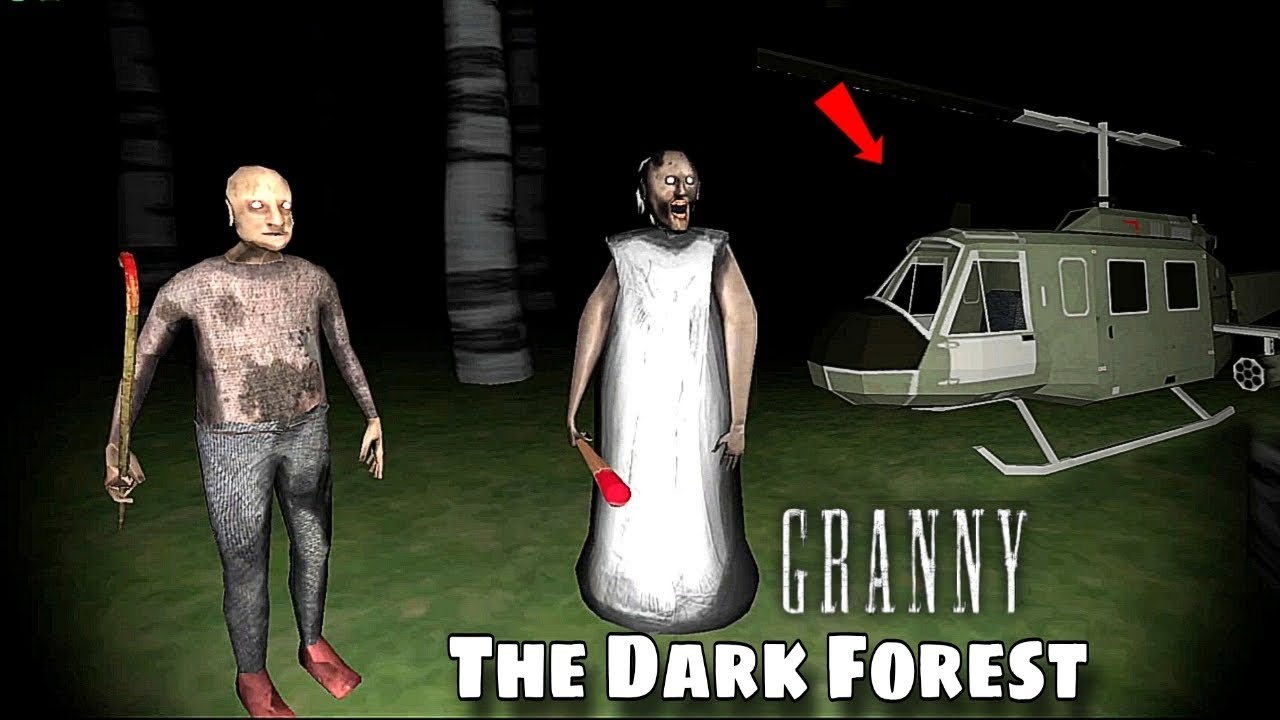
Granny's Dark Forest
1. Game Overview
Granny's Dark Forest moves the Granny formula out of confined interiors and into a nighttime woodland that creates an entirely different kind of dread. There are no walls to hide behind, no rooms to clear, no doors between you and whatever is shuffling through the undergrowth. Just trees, tangled roots, scattered junk between trunks, and a flashlight that flickers off the moment you stop moving — leaving you standing in complete darkness with only the sound of twigs snapping somewhere behind you.
The eight notes you need to find are never in the open. They're wedged under rocks, pinned to tree trunks at angles that require specific positioning, hidden where fallen branches stack up in ways that force you to crouch and look underneath rather than scan the area. The forest's ground-level search logic is entirely different from a house: there's no furniture to look behind, no drawers to open, just a dark woodland floor where anything could be pressed against a root or buried in debris.
Both Granny and Slenderman patrol the same forest simultaneously — and neither announces their presence until they're already close. Granny shuffles out from behind stumps. Slenderman slides between trunks in the fog. Getting caught by either sends you back to the start with notes randomized to new positions, meaning each new attempt is a genuine fresh search rather than a repeated route. The noisy surfaces — gravel crunching, wet leaves sticking to your shoes — create sound risk in an environment where there's no cover to compensate for the noise you make getting there.
Key Details:
- Genre: Survival Horror / Exploration
- Difficulty Level: Medium–Hard
- Average Play Time: 15–30 minutes per session
- Best For: Horror fans aged 12+; players who enjoy outdoor exploration horror over confined-space tension; fans of Slenderman-style note-hunting with dual-enemy patrol pressure
2. How to Play
Getting Started:
- Keep moving to maintain flashlight function — The flashlight fades when you stop or slow significantly. Move continuously while searching rather than pausing in place to scan — stationary searches happen in near-darkness, which makes both note-finding and threat detection significantly harder.
- Search at ground level and against vertical surfaces — Notes are pinned to tree trunks and wedged under rocks and fallen branch piles rather than placed at eye level in open spaces. Crouch (C) when searching accumulations of debris and look for pinned notes at the base and lower sections of trees.
- Listen for terrain underfoot before committing to a path — Gravel and wet leaves generate noise that increases enemy alert risk. Before crossing a patch of difficult terrain, listen for Granny's or Slenderman's proximity. If either is audible nearby, find a quieter alternate path through the forest rather than crossing noisily.
- Backpedal immediately when you spot either enemy — Granny emerges from behind stumps and Slenderman slides between trunks — both without extended warning. The moment either becomes visible, reverse direction and put trees between you and them before they close distance.
- After a reset, search different areas first — Notes randomize to new positions on each reset. The area where you found notes on the previous run is less likely to yield them on the next. Prioritize previously unsearched sections of the forest at the start of each new attempt.
Basic Controls:
| Action | Input |
|---|---|
| Look around | Mouse |
| Move | WASD or Arrow Keys |
| Interact / pick up note | E |
| Duck / crouch | C |
| Pause | Esc |
Objective: Find all eight notes hidden throughout the dark forest — pinned to trees, wedged under rocks, buried in fallen branch debris — while avoiding Granny and Slenderman's simultaneous patrols. Maintain flashlight function through continuous movement, navigate around noisy terrain surfaces, and collect all eight notes before either enemy catches you. Each failed attempt randomizes note positions.
3. Game Features & Highlights
- ✓ Outdoor nighttime forest setting — A tangled woodland environment entirely unlike any indoor Granny game — no rooms, no doors, no fixed hiding spots — replacing confinement with open-space disorientation and fog-based concealment
- ✓ Flickering flashlight tied to movement — The flashlight fades when you stop or slow down, creating a direct mechanical link between movement pace and visibility — you must keep moving to see, even when staying still feels safer
- ✓ Eight randomized note locations — Notes reset to new positions after every failed attempt, ensuring that each run requires genuine re-exploration rather than repeating a memorized collection route
- ✓ Dual silent-approach enemy patrol — Granny and Slenderman both move through the forest without extended audio warning, appearing from behind environmental objects — stumps, tree clusters, fog patches — with minimal advance notice
- ✓ Terrain noise risk system — Gravel and wet leaf surfaces generate audible footstep sounds that increase enemy alert risk, creating path-choice decisions beyond simply navigating toward note locations
4. Tips & Strategies
Beginner Tips:
- Treat the flashlight's fade as your movement prompt. When it starts to dim, you're moving too slowly — accelerate before the light fails entirely rather than waiting for full darkness to prompt you. The fade is gradual enough to give you a half-second of adjustment time if you're paying attention to it.
- Check fallen branch accumulations systematically rather than at a glance. Notes wedged into branch piles are partially obscured by the debris around them — you need to position yourself close enough that the note's edge is visible before the E interaction prompt appears. Surface-level scanning from standing height misses most of them.
- Learn the difference between Granny's shuffling sound and Slenderman's near-silent approach. Granny generates footstep audio; Slenderman is quieter and relies more on visual detection. In low-light conditions when the flashlight is fading, Slenderman emerging from fog between trunks may arrive without audible warning — check fog-heavy areas visually rather than depending on audio alone.
Advanced Strategies:
- Develop a forest sectoring strategy across multiple runs. Divide the woodland mentally into zones and prioritize fully clearing each zone before moving to the next rather than following note discoveries linearly. Sectoring reduces the duplicate-area searching that unfocused exploration creates in a large, visually uniform forest.
- Use the forest's fog patches deliberately as concealment rather than treating them as visibility hazards. Both enemies can be lost in dense fog if you move through it rather than avoiding it — fog conceals you from enemy sight lines as well as concealing them from yours.
- Track which terrain types border the areas where notes tend to appear across multiple runs. Notes in forest-floor positions tend to cluster near specific environmental features — rocks, stumps, branch piles — rather than in open, clear ground. Learning to scan for these feature types rather than searching uniformly speeds up each run's note-finding pace.
What to Watch Out For:
- Stopping to search in darkness — The instinct when you find a promising search area is to stop and look carefully. In Granny's Dark Forest, stopping kills the flashlight. Always maintain slow forward movement during searches rather than standing still — moving slowly is enough to keep the light functional, and a dim but functional flashlight is significantly better than complete darkness.
- Assuming a path is safe because you've walked it once — Granny and Slenderman reposition continuously. A corridor between trees that was clear on your last pass may have one of them behind it on your next crossing. Re-check auditory and visual signals before using any familiar path rather than walking it automatically.
5. Game Elements Explained
The Flickering Flashlight Mechanic Granny's Dark Forest's flashlight system creates a mechanical link between movement and visibility unlike any other game in the Granny genre. In most horror escape games, a flashlight is a static tool — on when held, off when not, with battery life as the limiting resource. In Granny's Dark Forest, the flashlight's brightness is directly tied to your movement velocity. Stop moving and the beam fades almost immediately. Move slowly and it provides dim, partial illumination. Maintain consistent walking pace and it functions reliably. This system creates a tension between the two things searching requires: movement to maintain light, and stillness to examine specific spots carefully. The mechanic resolves this tension by rewarding slow, continuous movement over stop-and-search behavior — players who maintain forward momentum during searches, scanning while walking rather than pausing to look, keep their light functional and their threat detection active simultaneously. Players who stop to search in darkness are less likely to find notes and significantly more likely to miss an approaching enemy until it's too late to react.
The Note Randomization and Reset System The eight notes in Granny's Dark Forest reset to new positions every time a run fails and restarts. This randomization system fundamentally changes how the game's replayability works compared to standard Granny-formula games. In most entries, repeated runs teach you where items are — note locations become memorized, and subsequent runs are faster because of accumulated route knowledge. In Granny's Dark Forest, route knowledge from previous runs is partially transferable (you know which environmental features notes spawn near — rocks, branch piles, tree bases) but the specific locations within those feature categories change each run. The result is a game that remains genuinely exploratory across multiple runs rather than becoming a mechanical execution of a memorized sequence. The note randomization also means that post-reset runs genuinely require fresh searching — going directly to where the last note was in the previous run is a consistently inefficient strategy.
The Dual Silent-Enemy Patrol System Granny and Slenderman's simultaneous presence in the same outdoor forest environment creates a threat profile unlike any indoor multi-enemy game in the catalog. Indoor games with multiple enemies provide walls and rooms that compartmentalize threats — you know which section of the house each enemy is in based on audio from specific locations. The forest's open layout means both enemies can approach from any direction without the compartmentalization that rooms provide. Granny generates some audio (shuffling, footstep sounds on harder ground surfaces) that gives approaching-from-behind warning. Slenderman is near-silent, relying on appearing visually between trees in fog patches with minimal advance notice. Managing both simultaneously requires dividing your attention between audio monitoring (for Granny) and visual scanning of fog-heavy tree lines (for Slenderman) — two different sensory channels operating in parallel rather than a single detection system covering both threats.
6. Frequently Asked Questions
Q: How do I keep the flashlight from going dark? A: Maintain continuous walking pace movement throughout your exploration. The flashlight fades when you stop or slow significantly — keep moving at a consistent walk to sustain the beam. When you need to search a specific area, do so while walking slowly around it rather than stopping in place. The light functions at slow walking speed — you don't need to sprint to keep it on, just avoid stopping entirely.
Q: Where should I look for notes after a reset? A: After a reset, prioritize sections of the forest you didn't fully search in the previous run, or sections where you found notes before (since notes in similar feature types — rocks, branch piles, tree bases — tend to reappear near similar environmental features even when their exact positions change). Avoid going directly to the specific spots where notes appeared last run — they've randomized to new positions.
Q: What should I do when I see Slenderman between the trees? A: Move away from his position immediately, putting trees and fog between you and him. Slenderman's approach doesn't provide the extended audio warning that Granny's shuffling does — once you see him, you're already close enough that immediate directional retreat is necessary rather than lateral maneuvering. Move away from his current position and continue your search in a different section of the forest before returning to the area where he appeared.
Q: Does crouching (C) help avoid detection in the forest? A: Crouching reduces your movement profile and is useful for searching ground-level note positions — particularly under fallen branch piles and wedged-under-rock locations. Its detection-avoidance benefit is more relevant for note-finding positioning than for sustained stealth movement through the forest. The terrain noise system (gravel and wet leaves) is the primary detection risk during movement — crouching doesn't fully eliminate terrain sound but reduces your overall noise output during searches.
Q: Is Granny's Dark Forest playable on mobile devices? A: Granny's Dark Forest runs via HTML5/Unity WebGL in desktop web browsers. The control scheme — WASD, mouse, E, C — is designed for keyboard-and-mouse play on a desktop or laptop computer. Desktop play on Chrome, Firefox, Safari, or Edge provides the optimal experience. Mobile play is not recommended given the control layout and the precision movement required for terrain-noise avoidance.
7. Related Games You Might Enjoy
If you like Granny's Dark Forest, you might also enjoy:
- the House of Evil Granny - It offers another browser horror run with related survival, puzzle, or escape pressure.
- the Horrible Maze of Granny - It offers another browser horror run with related survival, puzzle, or escape pressure.
- Scary Granny Games Ghost Games - It offers another browser horror run with related survival, puzzle, or escape pressure.
Comments (0)
Add a Comment