






Game Description
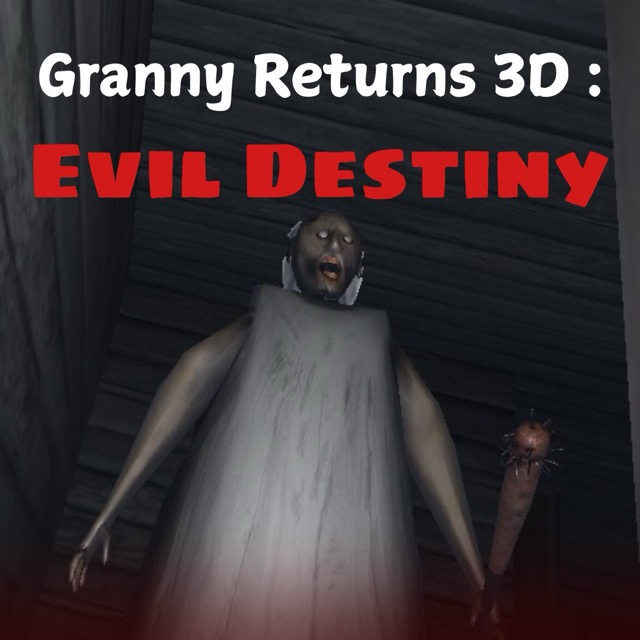
Granny Returns 3D: Evil Destiny
1. Game Overview
Granny Returns 3D: Evil Destiny is the site's most ambitious crossover horror escape — a single house containing six of the most recognizable antagonists in horror gaming simultaneously. Granny and Slenderina are already familiar from other entries in the catalog. Joining them: the Baby in Yellow, Freddy Fazbear from Five Nights at Freddy's, Huggy Wuggy and Mama Long Legs from Poppy Playtime. All of them, in one gloomy house, hidden in the shadows of an abandoned forest. All of them, at the same time.
The premise takes the Granny-formula stealth escape and multiplies its threat by six. Where standard Granny games ask you to track one or two antagonists across a manageable space, Evil Destiny asks you to navigate a house where six distinct behavioral systems are all active simultaneously. Each character has appeared in other games — in their respective franchises they're the primary horror — and here they're all secondary to the same objective: you need to find keys, collect weapons, and unlock the exit before any of them find you first.
The full toolkit reflects the complexity of what you're facing. Firearms with reload mechanics, melee attacks, crouch, jump, dedicated hide (E) and unhide (Q) controls, a clue system (O), and the ability to drop held items (G). This is the most mechanically equipped escape game in the catalog for a reason: six antagonists require more defensive options than one.
The 3D graphics and disturbing atmosphere are specifically designed to make every minute feel tense — footsteps behind you, creaking floorboards, sudden screams. Everything in the house works against you.
Key Details:
- Genre: Survival Horror / Escape Puzzle
- Difficulty Level: Hard — six simultaneous antagonists with distinct behaviors
- Average Play Time: 25–50 minutes per session
- Best For: Experienced horror escape players aged 13+; fans of Granny, FNAF, Poppy Playtime, and Baby in Yellow crossovers; players who want the highest-complexity multi-threat challenge on the site
2. How to Play
Getting Started:
- Identify each antagonist's audio signature immediately — Six characters produce distinct movement and ambient sounds. From the start, cycle through what you can hear and begin building a directional map of their positions before moving anywhere.
- Prioritize finding weapons early — With six active threats, the ability to stun or slow an antagonist blocking a critical path is not optional emergency equipment — it's standard operating procedure. Find and carry at least one defensive option before attempting any high-risk search zone.
- Use E to hide and Q to unhide deliberately — The dedicated hide/unhide controls exist because you'll use them frequently. Find cover before entering any room where multiple antagonists may be active, not after.
- Use O for clues when objective progress stalls — The clue system provides guidance on what to do next when the house's puzzle sequence becomes unclear. Use it proactively when you're uncertain rather than wandering blind through an environment with six active threats.
- Treat each character's proximity as requiring a different response — Granny reacts to sound; Slenderina reacts to gaze; Huggy Wuggy reacts to proximity and movement; each character has behavioral logic from their source games that carries into this one. Apply the correct response per character rather than a generic hide-from-everything approach.
Basic Controls:
| Action | Input |
|---|---|
| Look around | Mouse |
| Move | WASD or Arrow Keys |
| Clue | O |
| Interact / Hide | E |
| Shoot | Left Mouse Button |
| Reload | R |
| Run / Escape | Shift |
| Jump | Space |
| Unhide | Q |
| Crouch | C |
| Drop item | G |
Objective: Navigate the gloomy house, collect keys and weapons, and unlock the escape route while managing simultaneous encounters with Granny, Slenderina, the Baby in Yellow, Freddy Fazbear, Huggy Wuggy, and Mama Long Legs. Use the full toolkit — firearms, melee, stealth, and the dedicated hide/unhide system — to survive long enough to complete the escape sequence.
3. Game Features & Highlights
- ✓ Six simultaneous horror antagonists — Granny, Slenderina, Baby in Yellow, Freddy Fazbear, Huggy Wuggy, and Mama Long Legs all patrol the house at the same time — the largest simultaneous threat roster in the catalog
- ✓ Full tactical toolkit — Firearms with reload, melee attack, dedicated hide/unhide controls (E/Q), crouch, jump, item drop, and a clue system — a comprehensive defensive and navigational kit for managing six-character threat environments
- ✓ Crossover horror roster — Characters from five distinct horror franchises (Granny series, FNAF, Poppy Playtime, Baby in Yellow, Slenderina) in a single environment — immediate recognition value for fans across all represented series
- ✓ 3D atmospheric environment — Realistic 3D graphics in a forest-adjacent gloomy house setting, with footstep audio, creaking floorboards, and sudden screams creating a sustained tension layer beneath the six-threat management challenge
- ✓ Clue system for objective guidance — The O key provides directional clues for the escape sequence — an essential resource in a house where six active antagonists make extended aimless searching prohibitively dangerous
4. Tips & Strategies
Beginner Tips:
- Apply the correct behavioral response to each antagonist rather than treating all six as identical threats. Granny reacts to sound — stay quiet near her. Slenderina reacts to gaze — look away. Huggy Wuggy closes distance rapidly — create barriers. Each character's source-game logic is the guide to managing them here.
- The clue system (O) is your most important tool in an environment where six active threats make extended exploration dangerous. Use it early and often rather than treating it as a last resort — reducing time spent searching aimlessly directly reduces your exposure to all six antagonists.
- Carry the drop item key (G) in mind as an active tactical tool: dropping a held item creates noise in a specific location, which can redirect sound-reactive antagonists (primarily Granny) away from your current position.
Advanced Strategies:
- Develop a mental priority hierarchy for responding to simultaneous threats. When two or more antagonists are active near your position, respond first to whichever has the fastest approach speed or the most immediate consequence on contact — then address the secondary threat once the immediate one is resolved.
- Learn the house's furniture layout specifically for multi-antagonist encounters. In a six-threat environment, being caught between two characters with no cover available is the most dangerous scenario — knowing every cover position in every room before it's needed is more valuable here than in any single-threat Granny game.
- Use firearms selectively against antagonists who are physically blocking a key search zone with no bypass available, rather than as first-response tools. With six threats active, firearm noise from one encounter may attract additional antagonists — reserve shots for genuinely blocked situations rather than using them as opening responses to proximity encounters.
What to Watch Out For:
- Treating Slenderina like a sound-reactive threat — Slenderina's trigger is gaze, not noise. The quiet movement habits built for Granny encounters don't protect against Slenderina — she requires you to look away, not be silent. Mixing up behavioral responses between antagonists is how most early runs end in this game.
- Holding items unnecessarily — The G drop mechanic exists for a reason. Carrying items through the house when they're not immediately needed occupies an inventory slot and limits your weapon-carrying capacity. Drop non-essential items and retrieve them when needed rather than maintaining a full carry across antagonist-dense zones.
5. Game Elements Explained
The Six-Antagonist Threat Management System Granny Returns 3D: Evil Destiny's six-character roster creates a threat management challenge with no direct equivalent in the catalog. Single-antagonist Granny games require awareness of one behavioral system. Dual-antagonist games (Granny 2, Granny Horror 2) require parallel tracking of two. Evil Destiny requires simultaneous awareness of six, each operating on different behavioral triggers drawn from their source franchises. The management challenge is not simply additive — six threats don't create six times the complexity of one, they create an environment where the behavioral responses required for one character may contradict those required for another in close proximity. Staying silent for Granny while looking away from Slenderina while avoiding Huggy Wuggy's approach range while monitoring Freddy Fazbear's camera and audio zone while managing the Baby in Yellow's triggers — simultaneously — is the game's specific demand. Players who internalize each character's core behavioral logic from their source franchises arrive at Evil Destiny with the foundational knowledge for each management challenge; players without that background should prioritize learning each character's trigger independently before attempting to manage all six at full difficulty.
The Cross-Franchise Behavioral System Each of the six antagonists in Evil Destiny brings behavioral logic from their origin franchise into the house. Granny is sound-reactive — the core mechanic of every other Granny game on the site. Slenderina triggers on sustained gaze — her appearance requires immediate aversion rather than evasion. Freddy Fazbear from FNAF operates on the camera-and-door logic his franchise introduced — when he approaches, the defensive response is the blocking or monitoring behavior, not silent movement. Huggy Wuggy from Poppy Playtime is a pursuit-based threat that closes distance rapidly when triggered. Mama Long Legs adds a different proximity and detection profile. The Baby in Yellow introduces yet another behavioral variant. This franchise-specific behavioral diversity is what makes Evil Destiny structurally unique: it's not a house with six Grannies, it's a house with six distinct types of horror each requiring the response its source game taught its players. Cross-franchise familiarity is a genuine mechanical advantage.
The Full Defensive Toolkit Evil Destiny's control scheme — the most extensive in any game on the site — reflects the complexity of managing six simultaneous threats. The dedicated hide (E) and unhide (Q) controls separate hiding from general interaction, allowing faster transition into cover without risking accidental item pickup or door opening during an emergency conceal. Firearms with reload mechanics provide stun and deterrence options for blocking encounters. The crouch (C) and jump (Space) add vertical and noise-profile movement dimensions. The item drop (G) creates deliberate noise for distraction purposes. The clue system (O) provides navigational guidance when extended searching is too dangerous to sustain. Each tool exists because the six-threat environment creates situations that single tools can't resolve — and the combination of all of them, used in context-appropriate sequence, is what makes sustained survival possible in a house this thoroughly occupied.
6. Frequently Asked Questions
Q: How is each antagonist different from the others? A: Each character operates on behavioral logic from their source franchise. Granny reacts to sound — stay quiet. Slenderina triggers on sustained eye contact — look away immediately when she appears. Freddy Fazbear uses surveillance and door-blocking logic from FNAF. Huggy Wuggy and Mama Long Legs from Poppy Playtime use proximity and pursuit behaviors. The Baby in Yellow has its own detection profile. Applying each character's source-game response is more effective than treating all six as identical threats.
Q: What does the O key (clue) do? A: The O key activates the clue system, which provides directional guidance on your current escape objective — which area to search next, which door is relevant, what item to find. In a house with six active threats, extended aimless searching is prohibitively dangerous — use the clue system proactively when objective progress stalls rather than as a last resort after exhausting exploration options.
Q: What should I do if two antagonists are between me and my objective? A: Assess which has the faster approach speed and address that threat first — using a hide (E), stun with firearm, or retreat. Once the immediate threat is resolved, reassess the second antagonist's position and apply the correct behavioral response for that character. If both are actively closing in with no cover nearby, use the G drop to create a sound distraction redirecting sound-reactive antagonists while retreating from sight-reactive ones.
Q: Is Granny Returns 3D: Evil Destiny appropriate for players new to the Granny series? A: It is not the recommended entry point. The six-antagonist structure assumes familiarity with stealth horror mechanics and ideally with several of the represented franchises. Players new to the genre should start with single-antagonist entries (Granny Horror, Horror Granny) before attempting Evil Destiny. Players familiar with Granny, FNAF, and Poppy Playtime will find their cross-franchise knowledge directly applicable.
Q: Is Granny Returns 3D: Evil Destiny playable on mobile? A: The game runs via HTML5/Unity WebGL in desktop web browsers. The full control scheme — WASD, multiple mouse buttons, O, E, R, Shift, Space, Q, C, G — is designed for keyboard-and-mouse play on desktop or laptop. Desktop play on Chrome, Firefox, Safari, or Edge is strongly recommended. Mobile play is not suitable for this game's control complexity.
7. Related Games You Might Enjoy
If you like Granny Returns 3D Evil Destiny, you might also enjoy:
- Granny 4 - It offers another browser horror run with related survival, puzzle, or escape pressure.
- Granny 2 - It offers another browser horror run with related survival, puzzle, or escape pressure.
- Granny 3 Original - It offers another browser horror run with related survival, puzzle, or escape pressure.
Comments (0)
Add a Comment